21st Century Math
We offer after-school programs for mathematically curious elementary and middle school students, based on curriculum developed at UCLA’s Olga Radko Endowed Math Circle.
We don’t just teach math. We teach students how to think—through math.
Our mission
Our primary mission is to show that math is even more beautiful than it is useful.Our secondary mission is to bridge the ever-widening gap between school and college.We designed this program for students who are ready to move beyond the standard school curriculum - not just faster, but deeper.The program introduces ideas typically encountered much later - sometimes in college - and makes them accessible, engaging, and intuitive for younger minds.
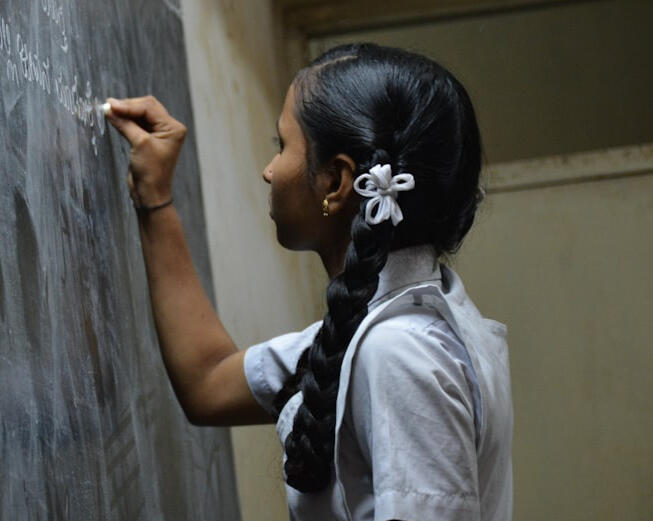
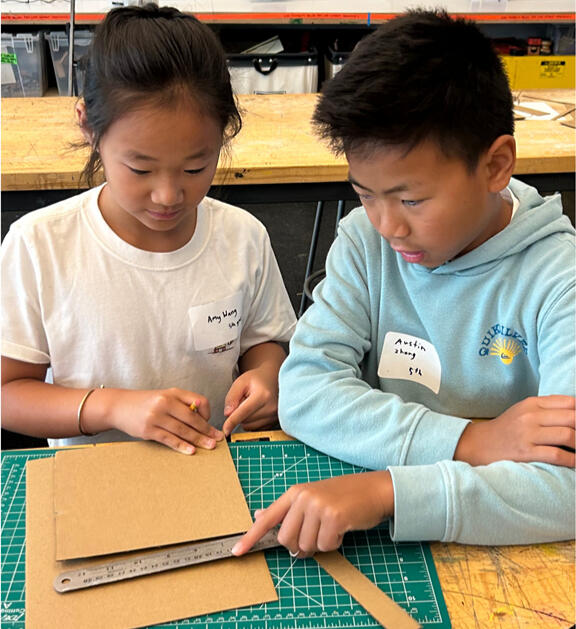
Elementary to High School
We offer a structured path from elementary through middle school, with high school programs available on demand.Students build knowledge over time through a curriculum designed to deepen understanding, not just accelerate it.
The Craft of Thinking
We treat thinking as a skill that can be developed.Through math, students learn how to break down problems, recognize patterns, test ideas, and communicate their reasoning clearly.
Passion for Mathematics
We believe math is not just useful - it’s beautiful.Our goal is to help students experience mathematics as something creative, elegant, and deeply engaging, on par with music or art.
Impact
We teach our students mathematics that will eventually enable them to create and interact with artificial intelligence (AI), optimize investment portfolios, etc. However, this is not our main goal. Our main goal is to show that math is the highest form of entertainment. It is even more beautiful than it is useful!
Classes
Our program covers all the levels from the 1st grade to the end of high school in a carefully designed multi-layer way..

Frequently asked questions
What is the difference between 21st Century Math program and other popular online programs in math education?
Every program has it's own genetics. The AoPS (Art of Problem Solving) program was started by winners of national math competitions. Its main focus is to raise the next generation of math competitions' winners. RSM (Russian School of Mathematics) was started by two immigrants from the Soviet Union, an engineer and a school teacher. The focus of this program is on teaching the time-honored standard 20th century Eastern European school math. Our program was designed by UCLA professors of mathematics, also immigrants from the Soviet Union. The roots of the program lie in the Easter European Math Circle movement pioneered by the Soviets. However, the program was further developed to prepare American children for success in the 21st century American college and beyond. We look past math competitions. Our aim is graduate and post-graduate education and research.
Who is the target audience of the 21CenturyMath?
21CenturyMath enables students with a serious interest in mathematics to go much deeper and wider in their studies than the traditional school curriculum. Our students are typically among the strongest in their classroom and entire school. We have classes for all grade levels, K-12.ere.
What does "Modular approach" mean?
Our study materials, from kindergarten to 12th grade, are organized in a system that prepares children for success in college and beyond. On the one hand, we build the knowledge of modern day mathematics layer by layer. On the other hand, it is the nature of our program that students come and go. This fact of life requires a modular approach to teaching. Our courses and quite often topics covered in the courses are independent of one another in the short run. In the long run however, they form the layered system mentioned above. There is one exception to this rule: the course Breaking Numbers into Parts forms a single 2-year-long course for 1st and 2nd grade. This course cannot be broken into smaller independent modules.
Will there be homework?
It is very important that your child does our homework regularly and with due diligence. They may occasionally need parental help. Please encourage your children to spread the load evenly solving a problem a day and not leaving everything until the last moment. Failure to do homework may result in your child getting behind and losing interest in the course.
How can a parent help?
Parental participation is very important. Most often, children take our classes once a week. If a student does not reinforce the material covered in class at home, they would remember very little a week later. This is why each and every lesson in our courses is followed by homework. Parents are expected to encourage their children to do the homework throughout the week. It will help to evenly distribute the load so that a student does a bit of advanced math nearly every day. Active parental participation is required for a child’s success in all of our elementary and middle school courses! At the beginning of almost every homework, a child is asked to explain to their parents the main concept of the lesson covered in class. A parent listening with genuine interest, asking questions and occasionally playing a bit goofy is a huge motivator! Unless you are a STEM-area professional, be prepared to learn a lot of math with your child!
Do you give tests and quizzes?
Each major topic covered in a course is followed by a quiz. The purpose is to check how students have learned the material. If the quiz indicates that many students have a far-from-perfect understanding of some part of the curriculum, we will review the part. Practice shows that the feedback the quizzes give is invaluable! To ease the fear of testing some students may have, we use the following approach. Before a quiz, we tell students that in our courses quizzes test not students, but teachers. If a student gets a low grade, it means that us teachers could do a better job. Then we ask students to come prepared and not to let us down!
My child is doing math 2-3 years ahead of the regular school curriculum.
Should I apply for a higher level of 21CenturyMath?
No. The mathematical concepts studied at 21CenturyMath go well beyond the standard school curriculum. Most of our students are 2 - 4 years ahead of their school grade level. This in itself is not necessarily an indicator of how well they will be doing at 21CenturyMath. Please apply for the age-appropriate level. Your child will be moved up, if we determine through classroom observations that this is in the best interest of the student.
How can I determine what level of the 21CenturyMath my child should apply for?
Please always apply for the suggested grade level, see page "Classes". If a student is admitted into the program, they will always start with the age-appropriate group. In rare cases, we move students one level up and sometimes even two levels up. This works best when it is initiated by the groups' instructors, following classroom observations. Please do not apply for a level that corresponds to a grade level higher than your child’s grade level at school.
My child was in the Beginner 1 group last year.
Will he be in the Beginner 2 next year?
Students in good standing are moved together as a group. Each of our levels is a two-year program. Students usually spend two years at the BNP Level, two years at the Beginners 1 level, two years at the Beginners 2 level, two years at the Intermediate 1 level, etc.
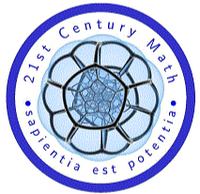
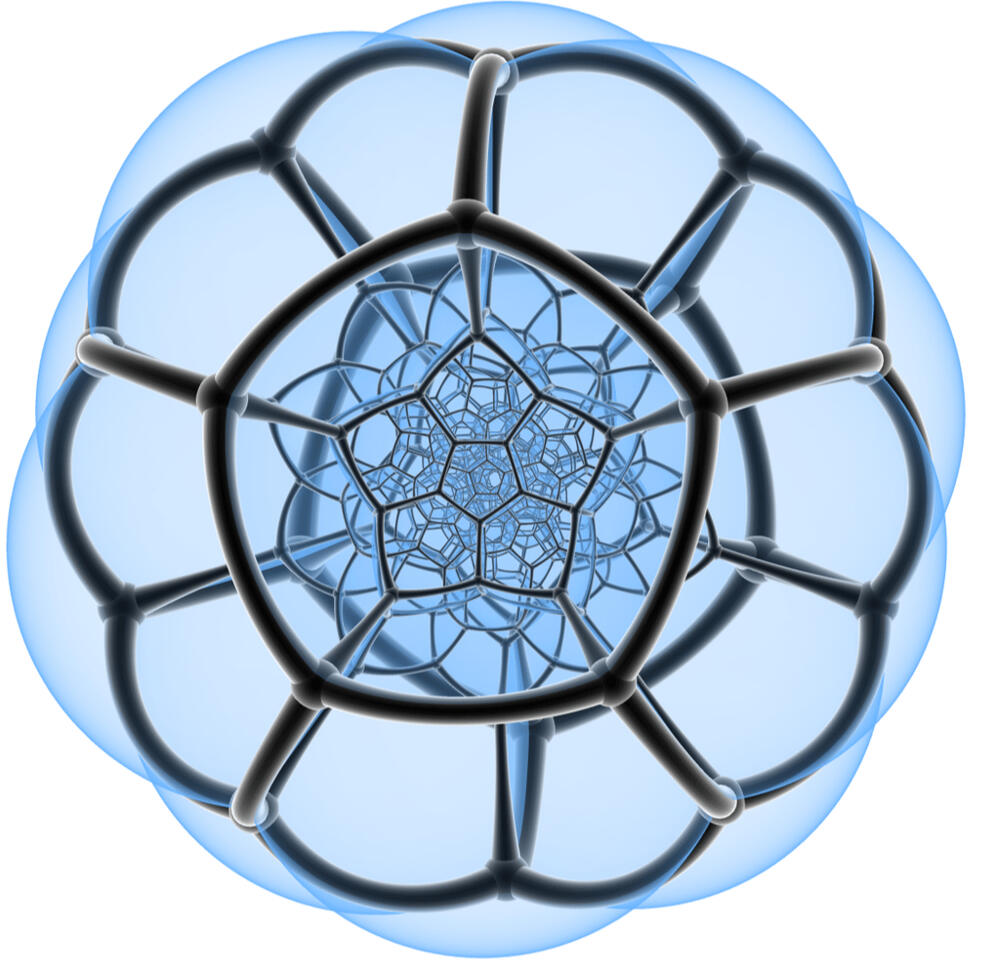
What is the meaning of the intricate figure on your logo?
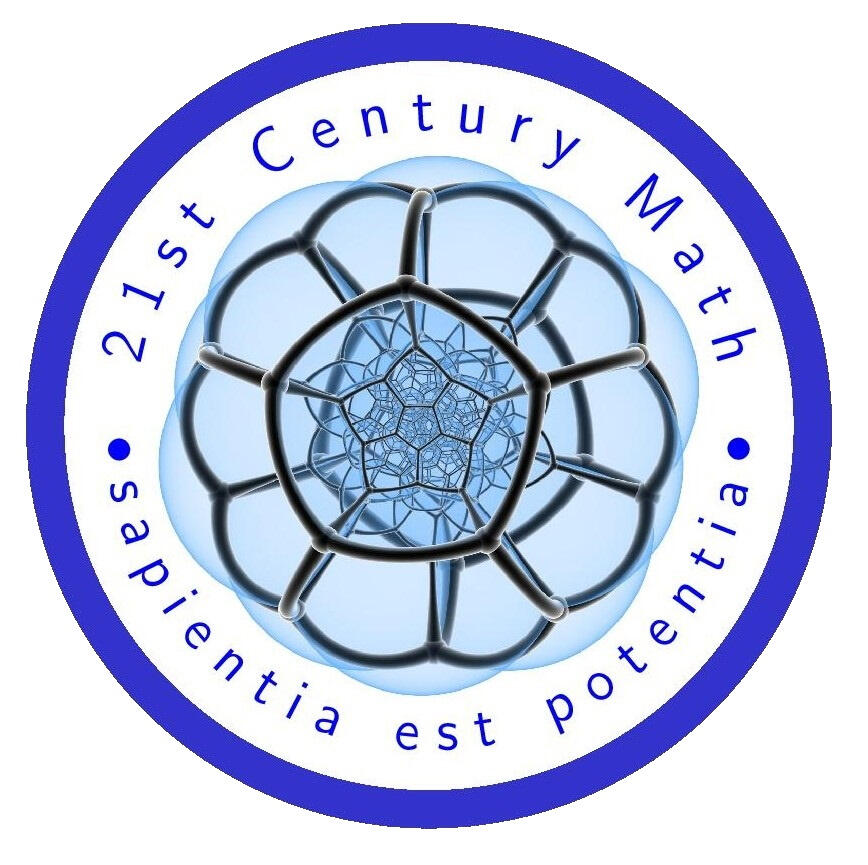
This is a picture of a 3D projection of the most symmetric solid of all dimensions, a 4D polytope called 120-cell. Each of its one hundred and twenty 3D walls is a regular dodecahedron.
Are there any holidays when 21CenturyMath does not meet?
Yes. Each semester, we skip a Sunday or two due to a long weekend:
Fall: we skip the Sundays of the Veterans Day and Thanksgiving weekends.
Spring: we skip the Sunday of the Memorial Day weekend.
We meet on all other Sundays that fall into our academic year calendar.
Testimonials
"We have two children in the program in Eric's classes. Our youngest is in kindergarten and she is younger than the other students in her class, but Eric never puts her on the spot, while still always giving her a chance to engage when she can. In our older child's class, Eric always keeps the kids engaged with humor, patience, and a focus on understanding the underlying concept, whether or not you get the right answer. (Eric tells them he gets things wrong as much as they do, which is why he always has them check his work.) The material is completely different from what they learn in regular school -- more like the kinds of fundamental concepts you would learn in college math -- and I can only imagine how helpful it would have been for me if I could have gotten exposure to these concepts so early."
Dan M.
BNP and Beginners 1
21st Century Math parent
television writer
"My 4th grade son became very motivated to master all his math facts after he started the math classes. The curriculum brings out the beauty of mathematics and shows students what fun they could have in learning it. The materials are challenging and encourage critical thinking. Class discussions are engaging and develop speaking skills as well. Students will be well prepared for advanced math studies and any analytical field with this curriculum. In addition, both me and my husband have fun thinking through the homework problems too. We highly recommend 21st Century Math classes!"
Carmen H.
Beginners 2 21st Century Math parent
"My son has joined this incredible math program at 21st Century Math since last fall and he loves it. I chose this program to support my son’s intuition and interest in mathematics and I’ve been fascinated by the unconventional approach that 21st Century Math math class promotes. It's impressive how teacher Eric’s class emphasizes comprehension over memorization or practice drills. Eric is very patient and actively engages students with math ideas by using intuitive examples and stimulates them to develop critical thinking/problem-solving skills. Instead of training to master a short term test, this class helps students build a life long foundation and understand ‘why’ deeply. This class is differentiated from other institutions in so many ways and we’re lucky to be part of it. I sincerely thank teacher Eric and 21st Century Math for such an awesome and unique program."
Jieun
BNP 21st Century Math parent
"... I wanted to inform you that we were informed that Kris is performing as the top student out of his class in math. The teachers asked Kris how he became so great at math, and he proudly informed them that he is learning math from the smartest guy in the universe Mr. Eric! Kris has a lot more challenges like with speech and writing which often cause teachers to not recognize his potential but your belief in him (and all the students), engaging techniques and cheerleading has changed Kris’s life, math gives him the pride and confidence in himself to succeed. We cannot thank you enough!"
Dr. Puja N. Trivedi
BNP 21st Century Math parent
Our Classes
Our classes are modular in nature. The study materials, from 1st to 12th grade, are organized in a system that prepares children for success in college and beyond. On the one hand, we build the knowledge of modern day mathematics layer by layer. On the other hand, it is the nature of our program that students come and go. This fact of life requires a modular approach to teaching. Our courses and quite often topics covered in the courses are independent of one another in the short run. In the long run however, they form the layered system mentioned above. There is one exception to this rule: the course Breaking Numbers into Parts forms a single 2-year-long course for 1st and 2nd grade. This course cannot be broken into smaller independent modules.Academic Year 2026–2027First Semester: September 27 – December 13, 2026
Thanksgiving Break (no classes): TBASecond Semester: January 10 – June 6, 2027
Spring Break: TBA
Memorial Day (no classes): May 31, 2027
BNP
BNP is a two-year-long enrichment course for children in grades one through two.
The course, based on the book Breaking Numbers into Parts, is designed for students in the first and second grade. The 1st edition of the book was featured in Washington Post. The second edition of the book we use in this course has two parts, both available on Amazon.
Year 1: Grade 1
Year 2: Grade 2
CURRICULUM
The course teaches 1st grade students to break (positive integral) numbers into parts in all the possible ways. The book the course is based on was tried and tested at UCLA Olga Radko Endowed Math Circle (ORMC), a free Sunday math school for mathematically inclined children run by UCLA Department of Mathematics. The book was used as a basis for a two-year long enhancement math course at a variety of other locations, from Math Circles and after-school programs to a full-fledged elementary school. The second edition of the book is a feedback-based improvement of the first edition. It has two extra chapters, more than sixty extra problems, solutions to harder problems, ten quizzes, and more.PERKS
The course gives students a novel approach to elementary arithmetic through the theory of partitions. We use the approach to prove commutativity of addition of positive integers in an age-appropriate fashion. Students also explore the concepts of digits and numbers, odd and even numbers, operations (functions), and inverse operations.

Beginners 1
The course is based on the book Math Adventures with ORMC, Level 1, From Optical Illusions to Fighting Dragons, Workbook, by Dr. Gleizer and Dr. Radko. Please click on this link to see the book on Amazon.Beginners 1 is a two-year-long enrichment course for children in grades three through four.Year 1: Grade 3-4
Year 2: Grade 4-5
CURRICULUM
The course is designed for mathematically inclined children 8 to 10 years of age. There are 33 lessons in the book. Each lesson takes two to three 50-minute-long sessions to cover. Each lesson is followed by homework. The lessons cover the topics ranging from advanced problem solving to graph theory to Roman and binary numbers to the one-sided surface known as the Mobius strip to vectors in the plane. We study the latter in the How to Kill a Dragon game.PERKS
We teach elementary school students the topics typically covered in college such as graph theory, game theory, topology, etc. Your child will not learn this material at school. The speed at which the material is presented in the US colleges makes it very hard for a college student to understand if they were not already familiar with the material to some degree. In one sentence, we build a bridge between school and college!
Beginners 2
Beginners 2 is based on the book, Math Adventures with ORMC, Level 2, From Ciphers to Nets of Solids, by Dr. Gleizer and Dr. Radko.
Workbook for students, Math Adventures with ORMC, Level 2, Ciphers, Functions, and Geometry of Time, is now available. Please click on this link to see the book on Amazon.Year 1: Grade 5-6
Year 2: Grade 6-7
CURRICULUM
The course is designed for mathematically inclined children 10 to 12 years of age. There are 35 lessons in the book. Each lesson takes two to three 50-minute-long sessions to cover. Each lesson is followed by homework. The lessons cover the topics ranging from ciphers to functions to solids and projections to introduction to logic and microchip design, and more.PERKS
We teach elementary school students the topics typically covered in college. At the Beginners 2 level, these are cryptography, introduction to mathematical logic and microchip design, geodesic lines on various objects, etc.
Intermediate 1
Intermediate 1 consist ofYear 1: Grade 7-8
Year 2: Grade 8-9
CURRICULUM
The classes are suitable for mathematically inclined children 11 to 13 years of age. The topics covered include: the Tower of Hanoi and the Sierpinksi Triangle, Egyptian multiplication and binary numbers, introduction to geometry, compass and ruler constructions, clock-face arithmetic, coordinates in the plane and on a sphere, functions and graphs, and geometry on the cylinder.
Intermediate 2
Intermediate 2 consist ofYear 1: Grade 8-9
Year 2: Grade 9-10
CURRICULUM
The classes are suitable for mathematically inclined children 13 to 14 years of age.
LESSON EXAMPLES:

Advanced 1
Grade 10-11
CURRICULUM
The classes are suitable for mathematically inclined children 14 to 15 years of age. The topics covered include Combinatorics & Graph Theory, Group theory and cryptography, Metrics and Distances, Information Theory, Cartography and Navigation among may other.

Advanced 2
Grade 11-12
CURRICULUM
The classes are suitable for mathematically inclined children 16 to 17 years of age. The topics covered include Modular Arithmetic, Finite fields, Vectors, Probability, Number Theory, Dynamical Systems among many other.
Our Curriculum
The curriculum developed by Dr. Gleizer and Dr. Radko has a foundation in the Eastern European Math Circles’ tradition. In the books by Dr. Gleizer and Dr. Radko, the curriculum has evolved to include many topics taught in the 21st century to US undergraduate math majors, redesigned for the cognitive level of younger students. We have ten years of experience of teaching this curriculum which we believe is currently the best in the world. We have taught it live at various venues and are currently teaching remotely.
Breaking Numbers into Parts
- BNP - 1 and 2 Grade
Counting stories
The first lesson of the course is an ice-breaker centered around a non-trivial and fun problem.
Parts of a number
They often ask in kindergarten and first grade to break a number into parts. For example, 5 = 2 + 3. In the standard curriculum, they always break numbers into two parts. In this lesson, we teach children to break a (positive integral) number into parts in all the possible ways, from one part on. For example, 5 = 5 is a way to break 5 into one part. It may seem trivial for the first look, but it is very important. One can also break 5 into two, three, four, and five parts. For example, 5 = 1 + 1 + 1 + 1 + 1
Partitions and subtraction
We used the technique of breaking a number into parts introduced in the second lesson to show students that addition and subtraction of whole numbers can be thought of as breaking numbers into parts.
The number line
We introduce the concept of the number line and show how to use the number line for addition and subtraction.
Digits and numbers
We show that numbers are made of digits the same way words are made of letters.
Young diagrams
We start calling the partitions introduced as "houses" in lesson 2 by their grown-up name, Young diagrams.
Harder subtraction problems
We show students how to use Young diagrams to solve harder subtraction problems.
Odd and even numbers
We use Young diagrams to introduce the concept of odd and even numbers.
Properties of add and even numbers
We use Young diagrams to study properties of odd and even numbers.
Commutativity of addition
We use Young diagrams to show students that x + y = y + x for any positive integers x and y. Most grown-ups are familiar with the fact, but very few can explain why it holds. The proof is given by means of playing the "build a house" game..
Adding more than two numbers
We use commutativity of addition to show students more efficient ways to add numbers.
For example, 8 + 7 + 6 + 2 + 3 + 4 = 8 + 2 + 7 + 3 + 6 + 4 = 10 + 10 + 10 = 30
Operations
We introduce functions in an age-appropriate fashion.
Compositions of operations and commutativity
We use operations to show that commutativity is a big deal in mathematics and in real life. If you doubt the latter, change the order of operations "put on socks" and "put on shoes" you routinely perform dressing up in the morning and then look at yourself in the mirror.
Inverse operations
We introduce the notion of an inverse function in an age-appropriate way.
Plane reflections and other symmetries
We study reflections of flat solids in straight line and other symmetries.
Conjugation of Young diagrams
We introduce an operation that swaps rows and columns of a Young diagram.
Conjugation as reflection
We show that a conjugation of a Young diagram is a reflection in its main diagonal.
Beginners 1
3-5 Grade
Advanced problem solving
Grown-ups usually solve problems we give our students in lessons 1 and 2 using variables and equations. The problems can be solved without employing the machinery of algebra. The more elementary approach requires visualization and deeper thinking, both replaced in the algebraic approach by the power of the machine.
Numeral systems
A large part of this mini-course is focused on giving students a better understanding of numbers. The numeral system currently in use by humanity is decimal place-value. The word decimal means that it has ten digits. The place value part means that the value of a digit depends on its position in a number.
For example, the digit 5 has the value five in a single-digit number 5, but it has the value five hundred in the three digit number 572.
To understand the workings and power of our numeral system, one has to take a look at a system that is decimal, but not place-value and at a system that is place value, but not decimal. In lessons 4 - 7 and 18, students study Roman numerals which are essentially decimal, but not place-value. In lessons 15 and 16, students take a deep look at the working of the decimal place-value system using the abacus as an efficient visualization tool. In lessons 20 - 23 and 28, we introduce students to binary numbers. Later on, we present a professional grade magic trick based on binary numbers that is totally mysterious to anyone not familiar with them.
Topology
Topology is a branch of math that studies properties of shapes preserved under continuous deformations, such as stretching, bending, and twisting, but not gluing, cutting, or making holes.
In lessons 9 and 10, we give students problems related to cutting solid cylinders and bagels. Answers to similar problems are different due the different topology of the objects cut.
In lesson 29, we study a one-sided surface, the famous Möbius strip, by comparing it to its two-sided cousin, a two-dimensional cylinder.
Combinatorics
Combinatorics is a branch of math that studies counting objects satisfying certain criteria. In lesson 12, we show children how to solve a highly non-trivial combinatorial problem of counting squares of all sizes, from 1 × 1 to 8 × 8 on a chessboard. We introduce graphs in various warm-up problems.
In lesson 22, we introduce a choice tree and (implicitly) permutations and combinations.
Game theory
In lesson 13, we introduce basic ideas of game theory and teach students how to always win playing a few cool games.
Coordinates and vectors
In lessons 30 and 31, we introduce coordinates in the plane as a tool to describe dragons and vectors in the plane as a weapon to fight them.
Review problems and questions
Lesson 32 is different from all other lessons of the book in structure and purpose. This lesson is a collection of problems similar to the ones given to students earlier in the course. Solving the problems reinforces understanding of the material covered during the year.
Beginners 2
5-7 Grade
Math Adventures Level 2 From Ciphers to Nets of Solids
Intro to ciphers
A cipher is a tool for reading and writing secret messages. In this mini-course we study the reverse cipher frequented by Leonardo Da Vinci, the Polybius cipher used by Ancient Greeks,
Caesar cipher, Pig Pen cipher and Rail fence cipher
Function machine and Mathematical notations for functions
When we introduce students to functions, we typically bring the concept to life through the idea of function machines. But functions will really begin to come to life as our students find uses for functions in the real world. FUNCTION MACHINES Students easily grasp the idea of a function machine: an input goes in; something happens to it inside the machine; an output comes out. Another input goes in; another output comes out. What's going on inside the machine? If we know the machine's function rule (or rules) and the input, we can predict the output. If we know the rule(s) and an output, we can determine the input. We also can imagine the machine asking, "What's my rule?" If we examine the inputs and outputs, we should be able to figure out the mystery function rule or rules.
A first look at the Geometry of Space - Polygons and solids
Students will learn basic facts about polygons. Then they will proceed to build some solids out of cubes and to draw their 2D projections.
A projection may be a 2D picture that shows us the "shape" of a side of a cube. Students will be given projections of the top, front, and left side of a solid that fits in the given dimensions of a cube. Can they identify the correct solid from this information? Or, is there more than one possible solution?
This mini-course will cover more complicated solids. we will be manipulating shapes in our heads and drawing their projections we are looking at 3D structures and their projections.
Children build 3D solids based on 2D projections. As well as having build a 3D solid and sketch the 2D projections
Intro to Mathematical Logic 1
Knights and liars, The truth function and the and operation, The or and negation operations, Double Negation and Logic gates.Here students will study the part of math called mathematical logic. Mathematical logic is one of the bedrocks of math and computer science.
Dimensions
Lineland, Flatland
The space we live in is called Euclidean after an Ancient Greek mathematician known as the father of Geometry, Euclid. Our space is three-dimensional. Another example of a Euclidean space is a 2D plane, modeled by the surface of a flat table or a blackboard. One feature of a Euclidean space is that for any two different points of such a space, there exists a unique shortest path connecting them. We call the shortest paths in Euclidean spaces segments of straight lines. A sphere is an example of a non-Euclidean 2D surface. There are infinitely many shortest paths, called meridians, connecting the North Pole of a sphere to its South Pole.
Backward Reasoning
Backward reasoning problems teach students to trace back the information flow.
Traveling on a Cube
We teach students to find the shortest path from one vertex of a cube to it's opposite in three different situations. In the first case, the cube is 3-dimentional (3D) and the shortest path is a segment of a straight line. In the second case, we consider a cube as a collection of its 1D edges. In this case, there're many different shortest paths of equal length. In the third case, we consider a cube as a collection of its 2D faces. To show students how to find the shortest paths in this case, we teach them cubic nets first.
Clock-Face Arithmetic
We teach students the arithmetic of the face of the clock and the more general
mod n arithmetic.
Introduction to Geometry
We begin the systematic study of geometry with Euclid's axioms. We proceed to compass and ruler constructions and prove the SSS, SAS, and ASA congruences of triangles. We then study the Pythagorean theorem.
Powers and Exponents
We teach students some basics about the functions y = xn and y = bx.
Arithmetic and geometric sequences and series
We teach this material in more depth than schools usually do, including the famous problem about an arrogant shah, a wise man and rice grains on a chessboard.
Intermediate 1
7-9 Grade
The Hanoi Tower puzzle and the Sierpinski triangle
The course, designed for students in grades 4-7, introduces children to recursive algorithms and related fractal sets. The course was created and tested at LAMC, Los Angeles Math Circle, a free Sunday math school for mathematically inclined children run by UCLA Department of Mathematics. Hidden in the jungle near Hanoi, the capital city of Vietnam, there exists a Buddhist monastery where monks keep constantly moving golden disks from one diamond rod to another. There are 64 disks, all of different sizes, and three rods. Only one disk can be moved at a time and no larger disk can be placed on the top of a smaller one. Originally, all the disks were on the left rod. At the end, they all must be moved to the right rod. When all the disks are moved, the world will come to an end. (No worries here, it will take the monks a few hundred billion years to complete the task.) This tale was created by a French mathematician, Edouard Lucas, to promote the puzzle he had invented. Called the Hanoi Tower, it's a great way to get introduced to recursive algorithms. A fractal is a self-similar geometric figure. Many fractals have fractal dimensions, hence the name. One of the simplest, and most famous, fractals is the Sierpinski triangle, named after a renown Polish mathematician, Waclaw Sierpinski. The dimension of the triangle is 1.584962... Yes, it's less than two, but more than one! The Sierpinski triangle and the Hanoi Tower puzzle are very closely related. To take the course, you will need to purchase the Hanoi Tower puzzle. There are a plenty of them an Amazon.
Place-Value Numerals 2
To fully understand the working of our system of numerals, decimal place-value, one needs to do two things. The first is to take a look at the decimal system that is not place-value. In this course, it will be the system that was in use in ancient Egypt. The second thing is to look at place-value systems with bases different from ten. In this course these will be the binary, trinary, octal, and hexadecimal. The first and the last are very important for anyone interested in understanding of how computers work. On top of that, students will learn that BADDAD and C0FEEBABE are actually (hexadecimal) numbers!
Egyptian multiplication
The numeral system we currently use is decimal place-value. The word "decimal" means that we use ten digits, zero through nine. "Place-value" means that the value of a digit depend on its place in a number. For example, the value of the digit 5 is five hundred in the number 538, but it is fifty in the number 51. To understand our numeral system in depth, a student needs to take a look at a numeral system that is decimal, but not place-value and at a system that is place-value, but not decimal. Egyptian numerals are decimal, but not place-value. Egyptian multiplication is in fact multiplication in the binary system, a system of numerals that is place-value, but not decimal.
Venn Diagrams
A quick and visual introduction to set theory and probability.
Transformations and permutations
A hands-on introduction to group theory.
Introduction to Basic Game Theory Part I and Part II
Exploration of game theory by starting with the example of subtraction games of varying subtraction sets. In Part II we will look at games, this time with more piles and complications.
Taxicab Geometry I and II
In Part I will be looking at distances with a twist. Normally we only consider the straight line distance (also known as Euclidean distance) or "as the crow flies" distance, but in this case we are looking at the Manhattan distance, where we are restricted. In Part II we will take a second look at non-Euclidean geometry and how shapes change under our new definition of distance.
Intermediate 2
9-12 Grade
The Number Lines
In this mini-course, students will get some basic understanding of numbers, real, rational, and irrational, including geometric construction of rational numbers. To do the latter, students will need a compass (geometric, not magnetic), straightedge, a few pencils, pencil sharpener, and eraser. Students will also learn how to compute square roots with precision exceeding that of a standard calculator. For that, student will need a laptop with the programming language Python installed. Python is a free download. https://www.python.org/ The course was created and tested at Geffen Academy, a middle and high school on UCLA campus, by the Geffen Academy Mathematics Department Chair, Dr. Oleg Gleizer.
Our program was designed by UCLA professors of mathematics, immigrants from the Soviet Union. The roots of the program lie in the Eastern European Math Circle movement pioneered by the Soviets. However, the program was further developed to prepare American children for success in the 21st century American college and beyond. Our aim is graduate and post-graduate education and research.
From the founders
The driving force behind this company is our desire to prepare children for the challenges of the 21st century global economy based on information technology. To do that, we have to start early. We need to introduce children to many more areas of modern day mathematics than the ones covered in the traditional school curriculum such as graph theory, combinatorics, algorithms, etc. We also believe that thinking is a craft with its own skillset. Math is just the most convenient playground for training a person skillful at thinking a.k.a. smart.
Our philosophy
The first pillar of our teaching philosophy is the idea that math is an ultimate form of art. When taught properly, math is even more entertaining than it is empowering. Here is an example of a problem we find very beautiful. Two ladies are sitting in a street café talking about their children. One says, "As you know, I have three daughters. The product of their ages equals 36. The sum of their ages equals the number of the house across the street. Would you be able to figure out how old each of my daughters is?" The other lady writes a few lines on a napkin and responds, "You didn't give me enough info." "Oh yes," agrees the first lady and adds, "my oldest daughter has beautiful blue eyes." Then the second lady figures out the age of each girl. Please note that the problem has a unique and not that hard to find solution. The second pillar of our teaching philosophy is that the curriculum should closely follow progress in science and technology, not trail a century or more behind. For example, the material we teach to students in grades 1 through 5 includes combinatorics, recursive algorithms, 4-dimensional geometry, topology, algebra of logic and microchip design, encryption, game theory, and more.
What to expect
The topics we teach at 21st Century Math go far beyond the standard school curriculum. By attending our program regularly for a number of years a student will get a well-rounded overview of topics from all fields of mathematics, from algebra and number theory to geometry and topology, including the modern day applications to cryptography. Whenever you join the 21st Century Math, you should not expect to understand everything right away. You will understand more and more as you get more experience.
Calendar
Academic Year 2026–2027First Semester: September 27 – December 13, 2026
Thanksgiving Break (no classes): TBASecond Semester: January 10 – June 6, 2027
Spring Break: TBA
Memorial Day (no classes): May 31, 2027Please note: We do not cancel Sunday or Monday classes for most federal and state holidays.

Ethan Kogan Middle and high school instructor.

Eric Kogan Owner and lead instructor

Irene Klyatskin Accounting and Billing

Vladimir Goryachev High school instructor

Nikita Gladkov Mathematical Olympiads instructor



General Application
To apply for a spot in the program follow a simple 2-step procedure:1. Enter parent information, name and email.
In the email subject box enter: new applicant or returning student.
2. In the message box add information about your child's age and grade level.
Math Competitions
We alternate our mini-course with Math Kangaroo preparation classes. Math Kangaroo is a nationwide contest for grades 1-12, offered annually on the third Thursday of March. The format of the contest in grades 1-4 is 24 questions given in the 75 minutes period of time. In grades 5 - 12, they give 30 questions in the same 75 minutes period. We encourage our students' participation in the competition. For more information and registration, please visit the Math Kangaroo’s web page.
Rules and Guidelines
1. Classes and levels placement.
Our placement is based on an assessment test's results, not on the grade level.
2. Classes and levels structure.
Students in good standing are moved together as a group. Each of our levels is a two-year program.
Thus, students usually spend 2 years in BNP, Beginners 1, Beginner 2, etc. and then move on to next leve
3. Come on time
We strongly discourage joining our ZOOM meeting late. Untimely arrivals are very disruptive to the sessions.
4. Be prepared
Have a 3 ring binder dedicated to our program materials. You will be putting handouts and worksheets into the binder.
Have scratch paper, pencils, pens and erasers ready. If asked by an instructor, bring additional supplies
(such as compasses and rulers for geometry sessions; calculators, graph paper, etc.)
Make your best effort in completing problems assigned for homework. If you have missed a session,
be sure to work through it at home.
Please note that as a rule, we respond to all requests and applications within 24 hours of receipt.However, we have been made aware that some of our email messages have been ending up in recipients' Spam folders.
Our company email addresses are:
[email protected], [email protected], and [email protected]Please make sure these addresses are not filtered into your Spam folder.
If you do find any of our messages there, please mark them as "Not Spam" to ensure all future communications reach you directly and without delay.
Thank you
Looking forward to seeing you in class.